Our history
The current LVI-INFO.fi product information database was introduced in 2009, and a self-service version was launched in 2010.
At present, the LVI-INFO.fi product information database contains approximately 180 000 products from more than 400 manufacturers and importers. LVI-INFO employs three people.
LVI-numero Oy was established in 2003, but the history of LVI-numbers began already three decades earlier.

How the idea of a shared database was born?
Few people know how the seven-digit LVI-number used to identify HVAC products came into existence. Behind the code is Timo Lahtinen, who served as Head of Information Management at the Finnish Association of Plumbing Wholesalers (Suomen Putkikauppiasyhdistys ry) from 1990 to 2004, and later as Managing Director of LVI-numero Oy, the company behind LVI-INFO.fi, from 2004 to 2006.
In the early days, each wholesaler used its own product codes for HVAC products. In 1969, the idea emerged of creating a shared register that would consolidate the product codes used by all parties operating within the HVAC industry.
Wholesalers, manufacturers, and contractors began working together to develop a common product register. As electronic information systems became more widespread, the timing was ideal. After several years of development work, a register was introduced in which ten-digit product numbers identified HVAC products sold in Finland. The product number consisted of a group identifier, a product-specific identifier, a fine code indicating variable product characteristics such as size, and a check digit.
However, the register was not fully comprehensive, the product numbers were too long, and the product information remained incomplete.
Road trip
In 1988, Timo began visiting companies that manufactured and supplied HVAC products. The goal was to create a system that would enable electronic data exchange between companies.
For an entire year, he travelled around the industry convincing companies of the need for a unified way to classify product information. Timo has said that companies were initially somewhat sceptical. It was difficult to commit businesses to a model in which information about their own products would be “revealed” to others.
The doubts gradually faded as the benefits of a standardized classification system became clearer.
The seven-digit LVI-number
A year later, in 1989, most customers had been convinced. The Finnish Association of Plumbing Wholesalers (Suomen Putkikauppiasyhdistys ry) and the Electrical Trade Association (Sähköteknisen Kaupan Liitto) agreed with the Finland Chamber of Commerce on the adoption of EAN numbers (now GTIN-13 codes).
Under the new model, the seven digits following the 64158 prefix in the 13-digit code would form the LVI-number, while the final digit would serve as a check digit. Customers could therefore choose to use either a GTIN code linked to the LVI-number or their own company-specific GTIN code.
A numbering structure was created in the LVI-INFO.fi system, and number ranges were allocated by product group.
The next major task was to convert the old ten-digit codes into seven-digit LVI-numbers. Lahtinen received support from HVAC industry professionals in carrying out the work. Once the reform was completed in 1990, the LVI-numbers were entered into the LVI-INFO.fi database, and dedicated number ranges were assigned to each customer within the numbering structure.
Marko comes on board
Marko Lätti was recruited to the Finnish Association of Plumbing Wholesalers from the register of an Onninen Express store in 2003.
At the beginning of the new millennium, creating LVI-numbers was far from simple. Customers sent product registration forms by fax, Marko manually entered the information into the system, and the newly assigned LVI-numbers were faxed back to the customers. In some cases, LVI-numbers were requested simply by faxing catalogue pages with circles drawn around the products requiring numbers. Occasionally, products were even registered based solely on a phone conversation, without any documentation.
“At the time, an LVI-number could be created with just a few basic details, such as the product name and dimensions,” Marko recalls with a laugh. “Back then, information such as country of origin or customs code was not required, even though today they are considered basic product data.”
Marko soon realized, however, that the numbering ranges were beginning to run out. Another challenge was the rigid structure of the LVI-number itself. Like its earlier ten-digit predecessor, the seven-digit LVI-number encoded information about the product group, product category, supplier, and product dimensions. Over the years, large numbering ranges had been reserved for customers, and the available number space was gradually becoming exhausted.
Transition to a neutral identification number
At the end of 2003, LVI-numero Oy was established, and a new approach was introduced in which technical product information was no longer encoded into the LVI-number itself. Instead, the technical information was linked to the product’s master data. While the first two digits of the LVI-number still indicate the product group, the remaining five digits no longer have any specific meaning.
“Many customers still believe that the LVI-number contains information such as the product size. This creates challenges when assigning new LVI-numbers, as it is impossible to allocate numbers from specific ranges to more than 400 customers,” Marko explains.
Instead, if customers wish to organize products by size when creating LVI-numbers, this can be done using their own product codes, Marko advises.
The current LVI-INFO.fi database was introduced in 2009, and a self-service version was launched in 2010. In 2025, more than 14 000 new LVI-numbers were created for customers, while approximately 12 000 products were archived.
Today, the LVI-INFO.fi product information database contains more than 180 000 products from over 400 manufacturers and importers.
The dynamic duo behind LVI-numbers
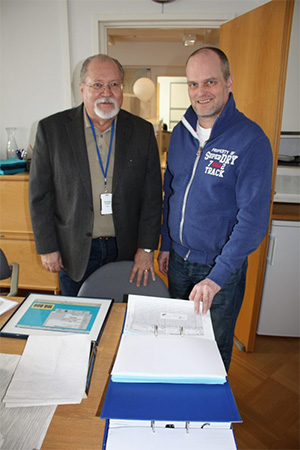
The LVI-INFO archives contain old fax documents that were used to create LVI-numbers for products at the beginning of the 2000s.
The photograph, taken in 2017, features Timo Lahtinen together with LVI-INFO’s first employee, Marko Lätti, who still works for LVI-INFO today.